Botanical Art
Nature-inspired florals, leaves, and organic plant illustrations
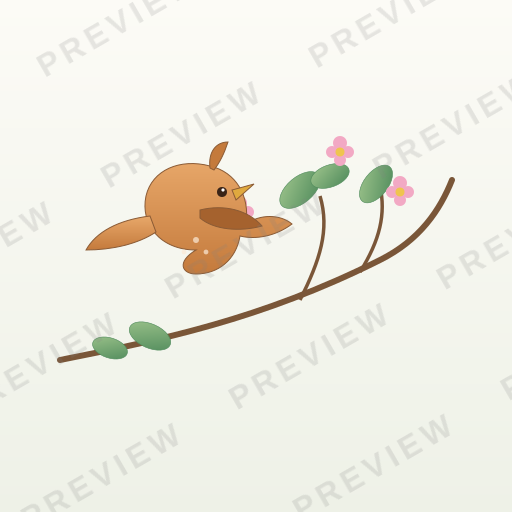
How do you make Botanical SVG art?
Describe any subject and pick the Botanical style — Clearly generates a clean, editable vector in seconds, with Botanical’s signature look (organic flowing lines, detailed leaf veins, natural asymmetry), ready for Cricut, print, or the web. No design software needed; free to generate and preview, with commercial-license exports on a plan.
About Botanical style
Botanical illustration brings the beauty of nature to your designs. From delicate wildflowers to lush tropical leaves, this style captures organic forms with artistic precision. Popular for wedding invitations, home decor, and eco-friendly branding.
History of Botanical
Botanical illustration's roots stretch to Dioscorides' De Materia Medica (c. 65 CE), but the modern scientific tradition emerged in 16th-century Europe when the "Fathers of Botany" — Brunfels, Fuchs, and Bock — produced the first printed illustrated herbals. The 17th century brought Dutch floral still life paintings and the great florilegia — flower books compiled for aristocratic gardens.
Carl Linnaeus's systematic taxonomy (1735) shifted illustration toward detailed studies of flowers and reproductive structures. The golden age (1750–1850) was driven by global exploration — Sydney Parkinson sailed with Captain Cook, the Bauer brothers documented Australian flora, and Pierre-Joseph Redouté painted roses for Empress Josephine at Malmaison. Curtis's Botanical Magazine, founded 1787, remains the world's oldest continuously published botanical periodical.
While photography gradually displaced hand illustration for scientific publication, botanical art continues as both a scientific and fine art tradition at institutions like Kew Gardens. Its influence on contemporary design is everywhere — from wedding stationery to sustainable brand packaging to interior décor.
Key Botanical artists
Maria Sibylla Merian
Pierre-Joseph Redouté
Georg Dionysius Ehret
Sydney Parkinson
Franz & Ferdinand Bauer
Iconic Botanical works
Merian, Metamorphosis Insectorum Surinamensium (1705)
Redouté, Les Roses (1817–1824)
Besler, Hortus Eystettensis (1613)
Curtis's Botanical Magazine (1787–present)
Banks's Florilegium (1768–1771)
Cultural significance
Botanical illustration sits at the intersection of art and science — every petal vein and stamen must be accurate enough for identification, yet beautiful enough to inspire. This dual mandate makes it one of the most disciplined and enduring illustration traditions in history.
Style characteristics
- Organic flowing lines
- Detailed leaf veins
- Natural asymmetry
- Varied line weights
- Realistic proportions
Best for
- ✓Wedding invitations
- ✓Home decor
- ✓Eco branding
- ✓Packaging
- ✓Journal decorations
Create Botanical art with AI
Describe your vision
Tell AI what you want in botanical style.
AI generates
Get a unique botanical SVG in seconds.
Download & use
Editable SVG for any project — commercial use on a paid plan.
Related art styles
If you like Botanical, explore these similar styles.
Scientific Botanical
Precise specimen-quality plant renderings with scientific accuracy
Minimal Botanical
Simplified elegant plant forms with modern aesthetic restraint
Wildflower
Natural loose meadow arrangements with organic, untamed beauty
Tropical Botanical
Lush tropical foliage with monstera, palm fronds, and exotic plants
Botanical Wreath
Circular floral frame compositions for invitations and decorative borders
Browse Nature & Botanical styles
Explore all styles in this category, or browse the full Style Encyclopedia.
Scientific Botanical
Precise specimen-quality plant renderings with scientific accuracy
Minimal Botanical
Simplified elegant plant forms with modern aesthetic restraint
Wildflower
Natural loose meadow arrangements with organic, untamed beauty
Tropical Botanical
Lush tropical foliage with monstera, palm fronds, and exotic plants
Botanical Wreath
Circular floral frame compositions for invitations and decorative borders
Botanical SVGs by category
Browse botanical designs for a specific subject — each generated to order, then editable.
Botanical Animals
Animals in botanical style.
Botanical Flowers
Flowers in botanical style.
Botanical Nature
Nature in botanical style.
Botanical Holidays
Holidays in botanical style.
Botanical Food & Drinks
Food & Drinks in botanical style.
Botanical Sea Life
Sea Life in botanical style.
Botanical Basic Shapes
Basic Shapes in botanical style.
Botanical Crafts & DIY
Crafts & DIY in botanical style.
Botanical Borders & Frames
Borders & Frames in botanical style.
Frequently asked questions
01What is Botanical art?+
02What are the key characteristics of Botanical style?+
03Can I generate Botanical SVGs with AI?+
04Who are the most famous Botanical artists?+
05What are famous examples of Botanical art?+
Ready-made
Ready-made Botanical vectors
Hand-curated botanical SVGs, licensable now — $<OneTimePrice /> once, commercial use, no subscription.


Create Botanical art today
Generate unique botanical SVG designs with AI. Preview free, no design skills needed — $<OneTimePrice /> once for a commercially-licensed SVG, no subscription.