Mascot Logo Art
Character-based brand identities with personality and approachability

How do you make Mascot Logo SVG art?
Describe any subject and pick the Mascot Logo style — Clearly generates a clean, editable vector in seconds, with Mascot Logo’s signature look (character-based design, friendly personality, distinctive silhouette), ready for Cricut, print, or the web. No design software needed; free to generate and preview, with commercial-license exports on a plan.
About Mascot Logo style
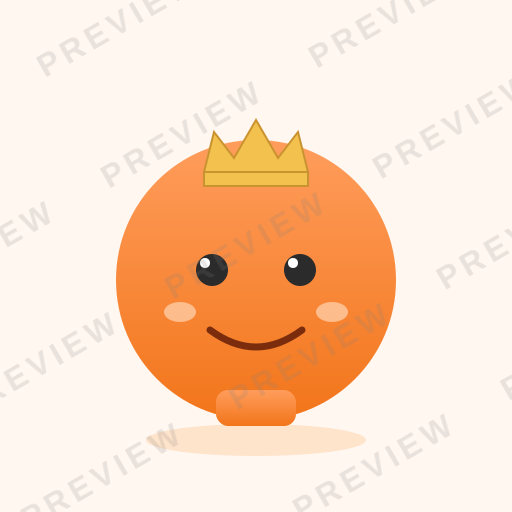
Mascot logo SVG gives brands a face and personality through character-based design. From the Michelin Man to the Mailchimp monkey, mascots create emotional connections that abstract marks cannot. With friendly expressions, distinctive silhouettes, and infinite storytelling potential, mascot logos build relationships with audiences.
About Mascot Logo design
Mascot logos are the most emotionally direct form of brand identity. By giving a brand a face — literally — mascot design taps into the human instinct to form relationships with characters rather than abstractions. The Michelin Man (1898), the Pillsbury Doughboy (1965), Tony the Tiger (1951), and the Mailchimp monkey (2001) are not just logos; they are brand personalities that audiences recognise, remember, and feel affection for in ways that geometric marks and wordmarks cannot replicate.
Mascot design sits at the intersection of character design, brand strategy, and illustration — disciplines that rarely overlap elsewhere in graphic design. The designer must create a character that embodies brand values, appeals to the target demographic, reproduces cleanly at every scale, and offers enough flexibility for storytelling across campaigns, packaging, social media, and merchandise. This is a much more demanding brief than designing a static mark, because a mascot must work in multiple poses, expressions, and contexts while remaining instantly recognisable.
The 2020s have seen a mascot renaissance driven by social media, where brands need personality-driven content to compete for attention. Characters generate higher engagement rates than abstract logos on Instagram, TikTok, and YouTube because they can emote, react, and participate in trends. Duolingo's owl, Headspace's orange dot character, and Discord's Wumpus demonstrate how mascots give digital-first brands a relatable face in an increasingly crowded attention economy.
Design principles
Silhouette-first design
A mascot must be recognisable from its silhouette alone — if you fill the character with solid black, the shape should still be identifiable. This ensures the mascot works at small sizes, in single-colour applications, and in motion.
Expressive range within consistency
The character needs a core design that supports multiple emotional states (happy, surprised, determined) without losing identity. Establish fixed proportions, signature features, and colour relationships that persist across every expression.
Brand-value embodiment
Every design choice — body proportions, colour palette, facial features, posture — should map to a specific brand attribute. A fitness brand mascot should feel energetic and strong; a children's education brand mascot should feel curious and approachable.
Scalable detail hierarchy
Design the mascot at three levels of detail: a full illustration with accessories and context, a simplified bust or head for medium applications, and a minimal icon version for favicons and small UI elements.
Design tips for Mascot Logo
Design the eyes first — they are the single most important element for emotional connection and will define the character's personality before anything else is drawn.
Give the mascot one signature accessory or physical feature (a hat, unusual ears, a specific colour pattern) that acts as a recognition shortcut even in simplified versions.
Create a basic character sheet with at least 5 expressions (neutral, happy, sad, surprised, determined) before finalising the design to ensure the character's face is flexible enough for real-world use.
Test the mascot on merchandise mockups (t-shirts, mugs, stickers) early in the process — mascots that look great on screen sometimes lack the visual impact needed for physical products.
Use cases
Food and beverage branding
Mascots give food brands a memorable spokesperson that can appear on packaging, in-store displays, TV commercials, and social media — creating a consistent personality across every consumer touchpoint.
Sports team identity
Athletic mascots embody team spirit and regional identity, appearing on jerseys, stadium graphics, merchandise, and as costumed characters at live events — the most multi-format logo application in existence.
Children's products and education
Character-based brands build trust with both children (who connect emotionally with the mascot) and parents (who perceive mascot brands as more child-friendly and approachable than abstract alternatives).
Social media and content marketing
Mascots generate significantly higher engagement on social platforms because they can react to trends, participate in memes, and create narrative content — something no geometric mark can do.
Gaming and community platforms
Gaming brands use mascots to build community identity and in-game presence, from Discord's Wumpus to GitHub's Octocat — characters that users adopt as part of their own digital identity.
Compare styles
vs. Abstract Logo Mark
Abstract marks communicate through pure form and colour without any representational content; mascot logos communicate through character, expression, and personality — trading geometric sophistication for emotional directness.
vs. Emblem Logo
Emblem logos may contain illustrative elements but are defined by their containing shape (shield, circle, badge) and symmetrical composition; mascot logos are character-first designs that break free of containing shapes and emphasise personality over formality.
Style characteristics
- Character-based design
- Friendly personality
- Distinctive silhouette
- Emotional connection
- Storytelling potential
Best for
- ✓Food brands
- ✓Kids products
- ✓Sports teams
- ✓Gaming brands
- ✓Community platforms
Create Mascot Logo art with AI
Describe your vision
Tell AI what you want in mascot logo style.
AI generates
Get a unique mascot logo SVG in seconds.
Download & use
Editable SVG for any project — commercial use on a paid plan.
Browse Logo, Icon & Commercial styles
Explore all styles in this category, or browse the full Style Encyclopedia.
Minimal Logo Mark
Clean geometric logo marks with single-weight strokes and timeless appeal
Emblem Logo
Classic crest and badge-style logos with ornate detail and heritage feel
Wordmark Logo
Custom typographic identities where the brand name IS the logo
Abstract Logo Mark
Dynamic overlapping forms with gradients for modern tech brands
Monogram Logo
Interlocking initials with luxury elegance and timeless sophistication
Continuous Line Logo
Single unbroken stroke logos with artistic modern minimalism
3D Logo
Dimensional marks with gradients, glossy effects, and modern depth
Line Icons
Consistent stroke-weight UI icons for interface and web design
Filled Icons
Solid bold icons with high visibility and strong visual weight
Duotone Icons
Modern two-color layered icons with depth and visual hierarchy
Isometric Icons
3D isometric perspective icons with technical precision and depth
Corporate Flat
Friendly rounded characters and solid fills for tech and SaaS branding
Isometric
Strict 30-degree perspective 3D illustrations with clean precision
Tech Product
Clean device outlines and UI mockups for product showcase illustrations
Modern Infographic
Clean data visualization with process flows and information hierarchy
Architecture
Accurate perspective drawings of buildings with technical precision
Mascot Logo SVGs by category
Browse mascot logo designs for a specific subject — each generated to order, then editable.
Mascot Logo Animals
Animals in mascot logo style.
Mascot Logo Flowers
Flowers in mascot logo style.
Mascot Logo Nature
Nature in mascot logo style.
Mascot Logo Holidays
Holidays in mascot logo style.
Mascot Logo Food & Drinks
Food & Drinks in mascot logo style.
Mascot Logo Sea Life
Sea Life in mascot logo style.
Mascot Logo Basic Shapes
Basic Shapes in mascot logo style.
Mascot Logo Crafts & DIY
Crafts & DIY in mascot logo style.
Mascot Logo Borders & Frames
Borders & Frames in mascot logo style.
Frequently asked questions
01What is Mascot Logo art?+
02What are the key characteristics of Mascot Logo style?+
03Can I generate Mascot Logo SVGs with AI?+
Ready-made
Ready-made Mascot Logo vectors
Hand-curated mascot logo SVGs, licensable now — $<OneTimePrice /> once, commercial use, no subscription.



Create Mascot Logo art today
Generate unique mascot logo SVG designs with AI. Preview free, no design skills needed — $<OneTimePrice /> once for a commercially-licensed SVG, no subscription.