Isometric Art
Strict 30-degree perspective 3D illustrations with clean precision

How do you make Isometric SVG art?
Describe any subject and pick the Isometric style — Clearly generates a clean, editable vector in seconds, with Isometric’s signature look (30-degree axonometric angles, no vanishing points, consistent depth), ready for Cricut, print, or the web. No design software needed; free to generate and preview, with commercial-license exports on a plan.
About Isometric style
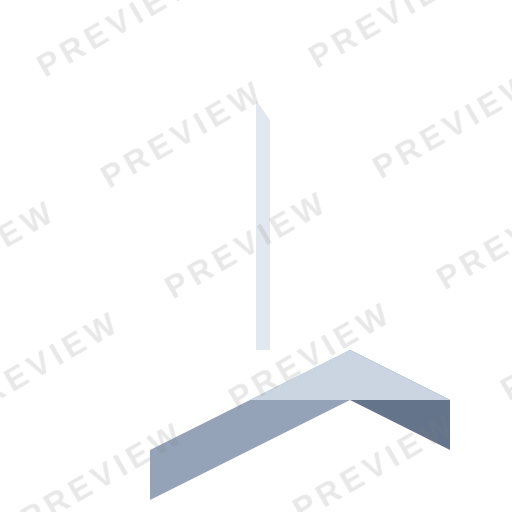
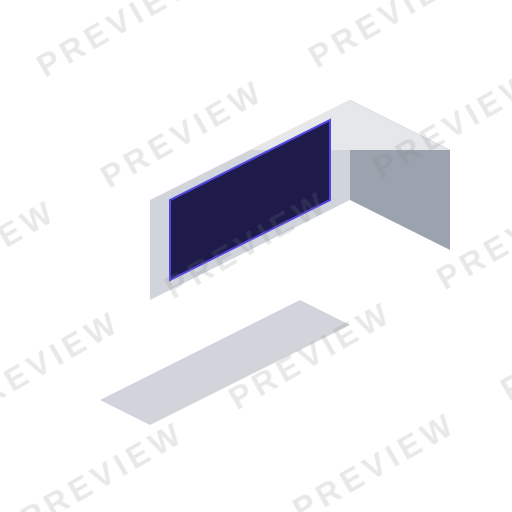
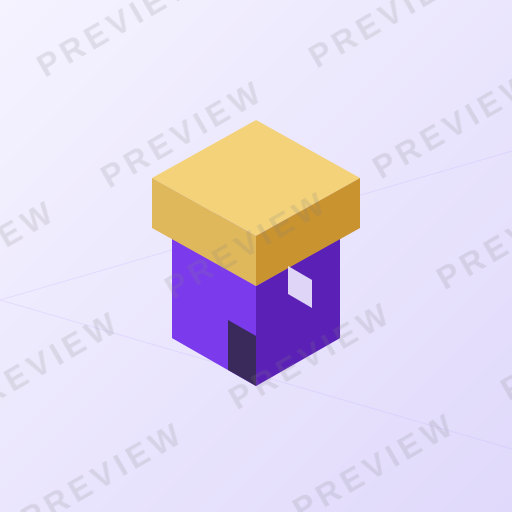
Isometric SVG illustration creates the illusion of three-dimensional space using a strict 30-degree axonometric projection. With no vanishing points and mathematically consistent perspectives, isometric art is perfect for technical diagrams, architectural visualizations, and the immersive workspace scenes popular in modern tech branding.
About Isometric design
Isometric illustration emerged as a dominant visual language in technology marketing during the 2010s, offering the depth and dimensionality of 3D rendering without the complexity of perspective drawing. The style's mathematical consistency — every object follows the same 30-degree angle rules regardless of position — makes it ideal for technical diagrams, architectural visualization, and the workspace diorama scenes that have become synonymous with modern tech branding.
The isometric approach originated in technical and engineering drawing, where it served as a precise communication tool for manufacturing and construction. Its migration into illustration and branding was driven by the same quality that makes it useful for engineers: every element maintains its proportions regardless of its position in the scene, making complex systems legible and comparable. This property is why isometric became the default style for infographics, process diagrams, and product ecosystem visualizations.
Modern isometric illustration has expanded well beyond its technical roots. The style's clean geometric nature makes it particularly well-suited to SVG format — every angle is mathematically precise, every shape is constructed from simple geometric primitives, and the lack of perspective distortion means elements can be reused and recombined freely across different compositions.
Design principles
Strict 30-degree discipline
All receding lines must follow exactly 30 degrees from horizontal. Even small deviations break the mathematical consistency that gives isometric its distinctive look and technical credibility.
No vanishing points
Unlike perspective drawing, parallel lines remain parallel. Objects do not get smaller with distance. This constraint is the defining characteristic — violating it creates a hybrid that looks like a mistake.
Consistent unit scale
Establish a base unit grid and build every element on it. A desk, a building, and a person should all clearly relate to the same measurement system, maintaining the technical drawing heritage.
Layer depth through overlap and shadow
Without perspective foreshortening, depth is communicated through element overlap, cast shadows, and vertical positioning. Higher elements read as farther away.
Design tips for Isometric
Set up a 30-degree isometric grid in your design tool before starting — freehand angles always drift and create inconsistency.
Build a library of reusable isometric primitives (cubes, cylinders, panels) that snap to your grid, then compose scenes from these building blocks.
Use subtle cast shadows on a ground plane to anchor floating elements and create clear spatial relationships between objects.
Maintain a single consistent light source direction (typically top-left) across all illustrations in a set to preserve the 3D illusion.
Use cases
Technology ecosystem diagrams
SaaS companies use isometric scenes to visualize how their product connects with other tools, showing data flows, integrations, and system architecture in an approachable format.
Office and workspace visualizations
Real estate, coworking, and remote-work companies use isometric office dioramas to showcase floor plans, amenities, and collaborative spaces without expensive 3D rendering.
Process and workflow infographics
Isometric step-by-step sequences visualize business processes, manufacturing workflows, and supply chains with the spatial clarity that flat diagrams lack.
City and urban planning presentations
Urban developers and municipal planners use isometric city blocks to communicate development proposals, zoning changes, and infrastructure projects to non-technical stakeholders.
Game environment and level design
Isometric projection is a foundational style for strategy and simulation games, and isometric SVG assets are used in game prototyping, marketing, and companion content.
Compare styles
vs. Architecture
Isometric uses a fixed 30-degree axonometric projection with no vanishing points, creating a toy-like, diagrammatic quality, while architectural illustration uses true perspective with vanishing points for photorealistic spatial depth.
vs. Tech Product
Isometric builds full environmental scenes and system diagrams in 3D space, while tech product illustration focuses on clean, flat device renderings and UI mockups.
Style characteristics
- 30-degree axonometric angles
- No vanishing points
- Consistent depth
- Clean geometric forms
- Technical precision
Best for
- ✓Tech infographics
- ✓Architectural plans
- ✓Product showcases
- ✓Process diagrams
- ✓Game environments
Create Isometric art with AI
Describe your vision
Tell AI what you want in isometric style.
AI generates
Get a unique isometric SVG in seconds.
Download & use
Editable SVG for any project — commercial use on a paid plan.
Browse Logo, Icon & Commercial styles
Explore all styles in this category, or browse the full Style Encyclopedia.
Minimal Logo Mark
Clean geometric logo marks with single-weight strokes and timeless appeal
Emblem Logo
Classic crest and badge-style logos with ornate detail and heritage feel
Wordmark Logo
Custom typographic identities where the brand name IS the logo
Abstract Logo Mark
Dynamic overlapping forms with gradients for modern tech brands
Mascot Logo
Character-based brand identities with personality and approachability
Monogram Logo
Interlocking initials with luxury elegance and timeless sophistication
Continuous Line Logo
Single unbroken stroke logos with artistic modern minimalism
3D Logo
Dimensional marks with gradients, glossy effects, and modern depth
Line Icons
Consistent stroke-weight UI icons for interface and web design
Filled Icons
Solid bold icons with high visibility and strong visual weight
Duotone Icons
Modern two-color layered icons with depth and visual hierarchy
Isometric Icons
3D isometric perspective icons with technical precision and depth
Corporate Flat
Friendly rounded characters and solid fills for tech and SaaS branding
Tech Product
Clean device outlines and UI mockups for product showcase illustrations
Modern Infographic
Clean data visualization with process flows and information hierarchy
Architecture
Accurate perspective drawings of buildings with technical precision
Isometric SVGs by category
Browse isometric designs for a specific subject — each generated to order, then editable.
Isometric Animals
Animals in isometric style.
Isometric Flowers
Flowers in isometric style.
Isometric Nature
Nature in isometric style.
Isometric Holidays
Holidays in isometric style.
Isometric Food & Drinks
Food & Drinks in isometric style.
Isometric Sea Life
Sea Life in isometric style.
Isometric Basic Shapes
Basic Shapes in isometric style.
Isometric Crafts & DIY
Crafts & DIY in isometric style.
Isometric Borders & Frames
Borders & Frames in isometric style.
Frequently asked questions
01What is Isometric art?+
02What are the key characteristics of Isometric style?+
03Can I generate Isometric SVGs with AI?+
Ready-made
Ready-made Isometric vectors
Hand-curated isometric SVGs, licensable now — $<OneTimePrice /> once, commercial use, no subscription.


Create Isometric art today
Generate unique isometric SVG designs with AI. Preview free, no design skills needed — $<OneTimePrice /> once for a commercially-licensed SVG, no subscription.