Pop Art Art
Bold 1960s-inspired flat colors, halftone dots, and comic book energy

How do you make Pop Art SVG art?
Describe any subject and pick the Pop Art style — Clearly generates a clean, editable vector in seconds, with Pop Art’s signature look (bold flat primary colors, ben-day halftone dots, heavy black outlines), ready for Cricut, print, or the web. No design software needed; free to generate and preview, with commercial-license exports on a plan.
About Pop Art style
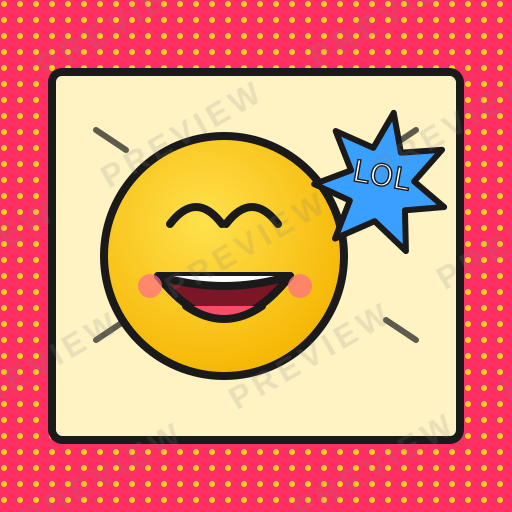
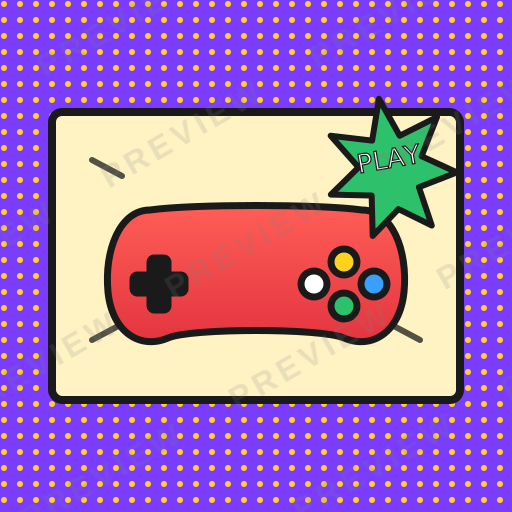
Pop Art SVG brings the explosive visual language of Warhol, Lichtenstein, and the 1960s art revolution into scalable vector format. Characterized by bold outlines, flat primary colors, Ben-Day halftone dots, and comic-book aesthetics, this style turns everyday subjects into eye-catching graphic statements. Perfect for posters, merchandise, editorial illustrations, and any project demanding maximum visual punch.
History of Pop Art
Pop Art erupted simultaneously in 1950s London and New York as artists rebelled against Abstract Expressionism's elitism by embracing mass culture. The Independent Group in London — Richard Hamilton, Eduardo Paolozzi — collaged advertisements and pulp imagery into fine art. Hamilton's 1956 collage "Just what is it that makes today's homes so different, so appealing?" is often cited as the first Pop artwork.
In New York, Andy Warhol's silk-screened Campbell's Soup Cans (1962) and Roy Lichtenstein's comic-strip paintings like Whaam! (1963) detonated in galleries. Warhol's Factory became a cultural nerve center, producing art, films, and music. His innovation was recognizing that repetition and commercial imagery could be fine art — and that the artist's brand could be the artwork itself.
Pop Art's legacy is immeasurable. It demolished the barrier between "high" and "low" culture, paved the way for Postmodernism, and invented the visual language of contemporary advertising, graphic design, and social media aesthetics. Every meme, every bold flat-color graphic, every ironic commercial appropriation traces back to Pop.
Key Pop Art artists
Andy Warhol
Roy Lichtenstein
Jasper Johns
Robert Rauschenberg
Claes Oldenburg
James Rosenquist
Richard Hamilton
Eduardo Paolozzi
Iconic Pop Art works
Warhol, Campbell's Soup Cans (1962)
Lichtenstein, Whaam! (1963)
Warhol, Marilyn Diptych (1962)
Hamilton, Just what is it... (1956)
Johns, Flag (1954–55)
Oldenburg, Floor Burger (1962)
Cultural significance
Pop Art was the first art movement born of mass media — and the last to fundamentally change how we see commercial imagery. By elevating soup cans and comic strips to gallery walls, Warhol and his contemporaries didn't just comment on consumer culture; they became it. Today's influencer economy, brand collaborations, and meme culture are all operating in Pop Art's conceptual framework.
Style characteristics
- Bold flat primary colors
- Ben-Day halftone dots
- Heavy black outlines
- Comic book aesthetics
- High contrast graphics
Best for
- ✓Poster designs
- ✓Merchandise prints
- ✓Editorial art
- ✓Social media graphics
- ✓Album artwork
Create Pop Art art with AI
Describe your vision
Tell AI what you want in pop art style.
AI generates
Get a unique pop art SVG in seconds.
Download & use
Editable SVG for any project — commercial use on a paid plan.
Related art styles
If you like Pop Art, explore these similar styles.
Browse Fine Art & Modern styles
Explore all styles in this category, or browse the full Style Encyclopedia.
Art Deco
1920s geometric luxury with gold accents, symmetry, and Gatsby glamour
Art Nouveau
Organic flowing curves, nature motifs, and Mucha-inspired elegance
Watercolor
Soft washes, organic bleeds, and translucent color layering
Pixel Art
Retro 8-bit and 16-bit blocky sprites with nostalgic gaming charm
Paper Collage
Layered torn paper textures with mixed-media cut-paste aesthetics
Mosaic
Tile fragment compositions with visible grout lines and classical beauty
Stained Glass
Bold black lead lines with jewel-toned translucent fills
Woodcut
Bold carved-look illustrations with strong black-white contrast
Travel Poster
Bold flat-color landmark compositions in vintage tourism poster style
Pop Art SVGs by category
Browse pop art designs for a specific subject — each generated to order, then editable.
Pop Art Animals
Animals in pop art style.
Pop Art Flowers
Flowers in pop art style.
Pop Art Nature
Nature in pop art style.
Pop Art Holidays
Holidays in pop art style.
Pop Art Food & Drinks
Food & Drinks in pop art style.
Pop Art Sea Life
Sea Life in pop art style.
Pop Art Basic Shapes
Basic Shapes in pop art style.
Pop Art Crafts & DIY
Crafts & DIY in pop art style.
Pop Art Borders & Frames
Borders & Frames in pop art style.
Frequently asked questions
01What is Pop Art art?+
02What are the key characteristics of Pop Art style?+
03Can I generate Pop Art SVGs with AI?+
04Who are the most famous Pop Art artists?+
05What are famous examples of Pop Art art?+
Ready-made
Ready-made Pop Art vectors
Hand-curated pop art SVGs, licensable now — $<OneTimePrice /> once, commercial use, no subscription.



Create Pop Art art today
Generate unique pop art SVG designs with AI. Preview free, no design skills needed — $<OneTimePrice /> once for a commercially-licensed SVG, no subscription.