Children's Book Art
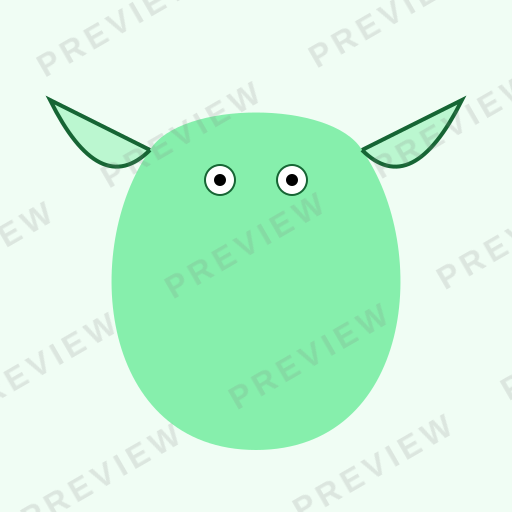
Soft, warm storybook illustrations with gentle colors and whimsical characters

How do you make Children's Book SVG art?
Describe any subject and pick the Children's Book style — Clearly generates a clean, editable vector in seconds, with Children's Book’s signature look (soft rounded shapes, gentle pastel palette, friendly character faces), ready for Cricut, print, or the web. No design software needed; free to generate and preview, with commercial-license exports on a plan.
About Children's Book style
Children's book SVG illustration creates the inviting warmth of bedtime storybooks in vector form. With soft rounded shapes, gentle pastel palettes, friendly character designs, and environments that spark imagination, this style connects with young readers and the parents who shop for them. Ideal for educational materials, nursery decor, and kid-friendly product packaging.
History of Children's Book
The children's picture book has a specific origin point: Randolph Caldecott (1846–1886), whose work first elevated the image from mere decoration into a narrative vehicle that extends the text. His picture books, including "The House That Jack Built" (1878), used dynamic compositions and expressive animals that were revolutionary. Maurice Sendak later declared: "Caldecott is the great picture book artist. He invented it." The Caldecott Medal, awarded annually since 1938, bears his name.
The 20th century transformed children's book illustration into a major art form. Beatrix Potter's "The Tale of Peter Rabbit" (1902) set new standards for naturalistic animal watercolors. Dr. Seuss revolutionized early readers with "The Cat in the Hat" (1957). Maurice Sendak's "Where the Wild Things Are" (1963) was a watershed — depicting childhood anger with psychological honesty that shocked adults, demonstrating that picture books could be artistically ambitious. Eric Carle's "The Very Hungry Caterpillar" (1969) introduced his distinctive hand-painted tissue-paper collage technique.
The late 20th and early 21st centuries brought diversification in both style and cultural representation. Quentin Blake's kinetic ink drawings became inseparable from Roald Dahl's stories. Chris Van Allsburg's dreamlike "The Polar Express" (1985) brought cinematic realism to picture books. Contemporary illustrators like Christian Robinson and Yuyi Morales bring diverse cultural perspectives and innovative mixed-media techniques, keeping the picture book one of the most vital art forms.
Key Children's Book artists
Randolph Caldecott
Beatrix Potter
Maurice Sendak
Eric Carle
Dr. Seuss
Quentin Blake
Ezra Jack Keats
Chris Van Allsburg
Iconic Children's Book works
Potter, The Tale of Peter Rabbit (1902)
Sendak, Where the Wild Things Are (1963)
Carle, The Very Hungry Caterpillar (1969)
Keats, The Snowy Day (1962)
Dr. Seuss, The Cat in the Hat (1957)
Van Allsburg, The Polar Express (1985)
Cultural significance
Children's book illustration is one of the most culturally significant art forms because it shapes visual imagination at its most formative stage. A great picture book illustration creates a world the child inhabits and returns to, embedding visual memories that last a lifetime. The field has also been a site of important debates about representation and whose stories deserve to be seen.
Style characteristics
- Soft rounded shapes
- Gentle pastel palette
- Friendly character faces
- Warm, inviting scenes
- Age-appropriate simplicity
Best for
- ✓Children's books
- ✓Nursery wall art
- ✓Educational apps
- ✓Toy packaging
- ✓Kids clothing
Create Children's Book art with AI
Describe your vision
Tell AI what you want in children's book style.
AI generates
Get a unique children's book SVG in seconds.
Download & use
Editable SVG for any project — commercial use on a paid plan.
Related art styles
If you like Children's Book, explore these similar styles.
Browse Illustration & Character styles
Explore all styles in this category, or browse the full Style Encyclopedia.
Kawaii
Cute Japanese-inspired characters with big eyes and soft features
Simple Kawaii
Round shapes with cute dot eyes and pastel color palettes
Kawaii Food
Adorable food items with cute faces, expressions, and personality
Kawaii Animals
Chibi-proportioned animals with oversized heads and adorable expressions
Planner Doodles
Small cute icons and decorations designed for bullet journal layouts
Whimsical
Playful, fantastical designs with storybook charm
Sticker
Vibrant die-cut ready illustrations with bold outlines and clean edges
Flat Design
Modern flat vectors with solid fills, no gradients, and clean geometry
Spot Illustration
Small focused micro-illustrations perfect for UI empty states and features
Fashion Illustration
Elongated figure proportions with couture elegance and editorial flair
Food & Drink
Appetizing culinary illustrations that make food look irresistible
Editorial
Bold conceptual compositions for magazines, blogs, and hero sections
Children's Book SVGs by category
Browse children's book designs for a specific subject — each generated to order, then editable.
Children's Book Animals
Animals in children's book style.
Children's Book Flowers
Flowers in children's book style.
Children's Book Nature
Nature in children's book style.
Children's Book Holidays
Holidays in children's book style.
Children's Book Food & Drinks
Food & Drinks in children's book style.
Children's Book Sea Life
Sea Life in children's book style.
Children's Book Basic Shapes
Basic Shapes in children's book style.
Children's Book Crafts & DIY
Crafts & DIY in children's book style.
Children's Book Borders & Frames
Borders & Frames in children's book style.
Frequently asked questions
01What is Children's Book art?+
02What are the key characteristics of Children's Book style?+
03Can I generate Children's Book SVGs with AI?+
04Who are the most famous Children's Book artists?+
05What are famous examples of Children's Book art?+
Ready-made
Ready-made Children's Book vectors
Hand-curated children's book SVGs, licensable now — $<OneTimePrice /> once, commercial use, no subscription.



Create Children's Book art today
Generate unique children's book SVG designs with AI. Preview free, no design skills needed — $<OneTimePrice /> once for a commercially-licensed SVG, no subscription.